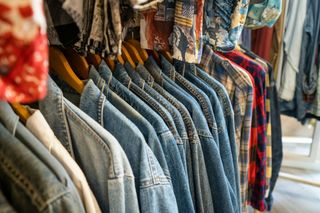
What does creme mean in used clothing?
Creme is the name sorters give to the best reusable clothing. A Dutch guide to textile sorting (Waag, 2021) lists at least 3 grades for reusable items. They are crème, first quality and second quality. It says crème sells at the highest prices, to second-hand and vintage shops in Western Europe.
Crème often includes branded items. The same guide gives Levi’s jeans and a Tommy Hilfiger sweater as examples. In Gikomba, Nairobi, a trade guide groups crème with camera. It describes them as top-quality, almost-new clothes that look like they just came from a store.
How much of the clothing is crème?
Not much. A January 2023 study by Norion, VITO and EigenDraads looked at how used textiles are sorted in Europe. It was written for EuRIC Textiles, part of the European Recycling Industries’ Confederation. It says crème makes up around 5% of collected volume in many countries. Nordic countries report 10–15%.
The study says sorters sell most crème on Western European markets. The rest of the reusable clothing goes to wholesalers for detailed sorting and export. It also reports that the share of crème in unsorted collected textiles is falling. That makes crème the scarcest and most expensive grade.
How do you order creme bales?
On a BaleBridge pro-forma invoice, crème is our Cream grade. You choose the grade and the category separately, for example Cream ladies’ tops or Cream jeans. Write one grade per line. A line such as “Cream/Grade A mix” gives an inspector nothing clear to check.
We do not own a sorting plant, so we choose a sorter in Europe for each order. An SGS or Bureau Veritas inspector checks opened bales before loading. The report is issued in your name. It shows whether the bales match the Cream grade on your invoice.